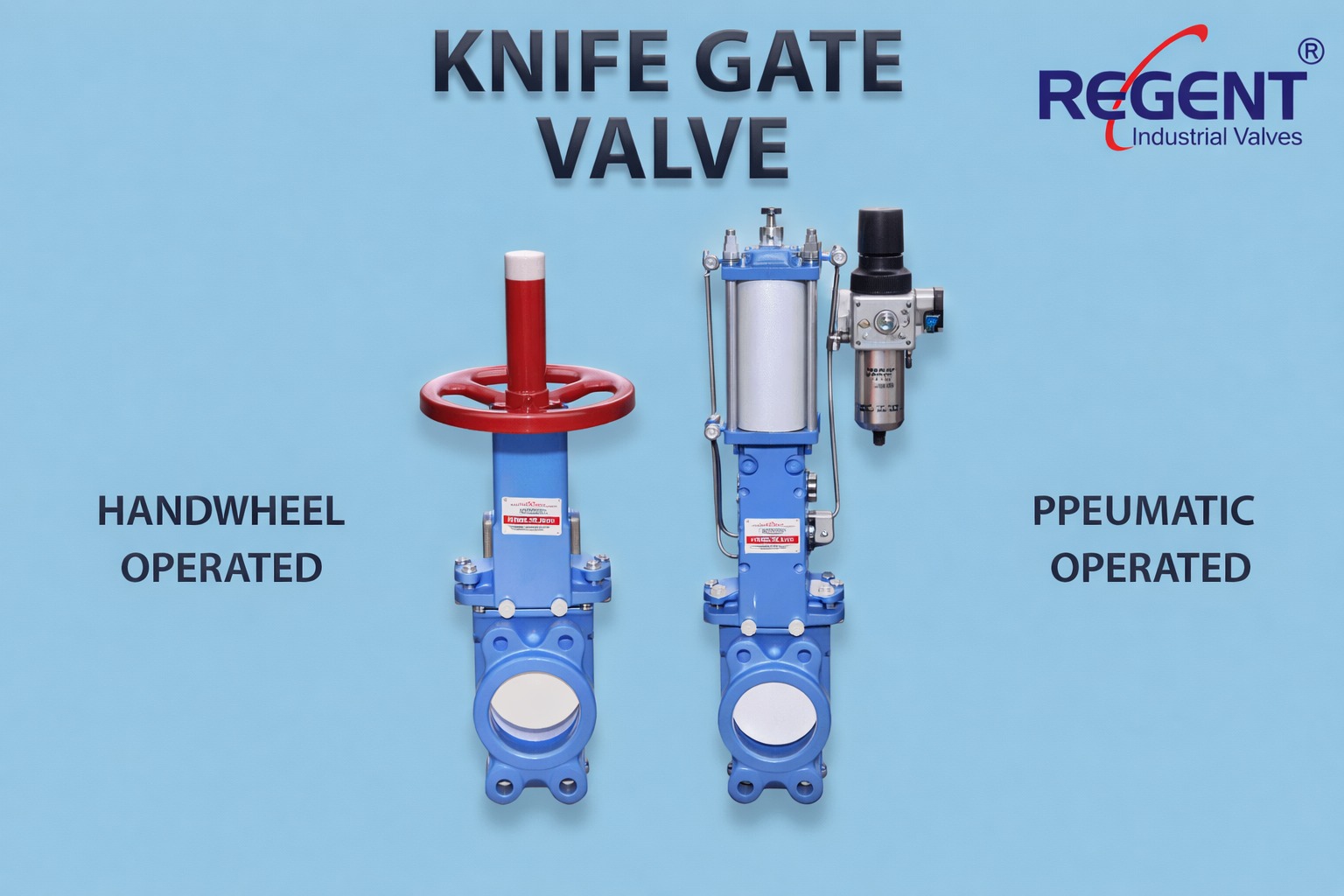

Fluid management is a key component in the operations of the industry to make them productive, safe, and reliable. The knife gate valve is one of the most effective products among the range of valves that are used in the difficult operations of managing the flow of fluids that contain solids, slurry, or solids with high viscosity. This special design enables the valve to slice through thick or abrasive fluids, and hence it offers smooth operation, less clogging and good reliability of on-off control.
Regent Hitech Private Limited is a major producer that offers quality gate valves that is designed to give performance, durability and conform to industrial standards. This manual provides all the information about the knife gate valves, such as design, types, features, pros, cons, uses, installation, troubleshooting, and commonly asked questions.
A knife gate or knife valve is a specialized type of linear motion gate valve that is intended to manipulate or isolate the flow of solids suspended in a fluid, slurry or a viscous liquid. The knife gate valve, unlike traditional valves, can be used in fibrous or thick media, which may not be completely compatible due to the design of the traditional valve. The sharp-edged gate can slice through solids, making it easy to operate, causing it to clog minimally and be able to provide reliable on-off operation.
These valves are primarily designed to be used in an on-off mode and should not be used in throttling. They come in manual, pneumatic and electric actuation to accommodate all the industrial needs.
The strong building, which is normally made of stainless steel, cast steel or alloy steel and the tough seats, which are often made of resilience or metal, will make the building resistant to corrosion, abrasion and high temperatures. Wastewater treatment, pulp and paper, mining, chemical processing, and power generation industries have been using the knife gate valve to manage the flow efficiently, with long life and low maintenance; hence, they are imperative in the challenging industrial processes.
The knife gate valve has been constructed in a way that provides it with durability and effectiveness in the demanding industrial environment. The main components include:
This carries the gate, stem and seats. Constructed of stainless steel, cast steel or alloy steel.
Linear motion component, which lifts or cuts the flow open or closed.
Coating against leakage, and composed of metal, rubber, or PTFE.
Attaches the actuator to the gate to move easily.
This is a manual, pneumatic or electrical operation of the valve.
Check to make sure the operation around the stem is leak-proof.
Covers the stem and actuator and helps in supporting the work of the valves.
Its robust construction will enable the valve to endure abrasive, corrosive and viscous fluids without depreciation.
The gate valve is an efficient, versatile and durable one. The most important features and their advantages are outlined in the following table:
|
Feature |
Key Benefit |
|
Sharp-Edged Gate |
Slices slurries and solids effectively using a gate valve |
|
Bi-Directional Sealing |
Stops leakages and provides a safe functioning of the knife gate valve |
|
Compact Design |
Fits easily in tight spaces |
|
Manual/Pneumatic/Electric |
Flexible operation options |
|
Abrasion and Corrosion Resistant |
Long-lasting and durable |
|
Low Maintenance |
Minimizes downtime and the cost of operations |
|
Minimal Pressure Drop |
Provides energy-efficient smooth flow |
To achieve a high service life and dependable working ability of the knife gate valve, it is important to select the appropriate one. The following should be taken into account:
Be sure that the valve is appropriate to the fluid; it may be solids, slurry, viscous liquids, or corrosive fluids.
The valve should have a rating against the operating pressure and temperature of the system to prevent leakages or breakage.
Select non-abrasive media, resilient seats and abrasive, high-temperature or corrosive fluid metal seats.
The type of actuation, i.e. manual, pneumatic or electric, should be in line with the operation requirements as well as the automation requirements.
Small designs can be easily installed in a limited space; larger valves can require more space.
To minimize downtime, it is desirable to select a valve that can be easily inspected, lubricated and changed to renew the seats of the seat.
By taking these points into consideration carefully, the knife gate valve can be made to have an efficient performance, long life, and meet your system's operational requirements.
Gate valves come in many designs, and they are used to fulfil industrial needs:
It is a valve that is operated by a handwheel or lever and that is used in low-pressure applications.
The systems utilize compressed air in automated systems, which are suitable in continuous operations.
Motorized is used to provide accurate control and remote-actuated operation.
Rising stem provides a visual cue; non-rising is non-bulky.
Resilient seats can be used with liquids; metal seats with high-temperature or abrasive media.
The knife gate valve has a number of strengths that render it the perfect option in the industrial sector that requires dealing with difficult fluids.
The sharp-edged gate design enables the solids-laden and slurry fluids to pass through the valve without clogging and flow freely.
The gate valve is a design with a straight-through flow path, which reduces turbulence and energy loss, resulting in efficient operation throughout pipelines.
The valve is made of anti-corrosive and anti-abrasive materials and can boast of long life due to its high temperature and increasing media tolerance.
The valve may be operated in manual mode, pneumatic mode or in any electric mode depending on the operation requirements and automated system.
It has a simple construction that entails fewer moving parts, thereby the low wear and tear, thus less downtime and cost of maintenance.
The space-saving design of the valve ensures that it can be installed despite offering limited or small spaces in the piping layout.
The knife gate valve offers great durability, low maintenance and efficiency, which makes it a cost-effective investment in the long term for use in harsh industries.
The knife gate valve has found extensive applications in any industry where the fluid has solids, slurry, or a viscous medium. It is a strong and efficient design, making it a good choice in a demanding application. Examples of common applications are:
● Wastewater Treatment Plants – These are used to separate the sludge and manage the passage of sewage and wastewater lines.
● Pulp and Paper Industry – Pulp suspension and fibrous liquid are easily disposed.
● Mining and Mineral Processing – Regulates slurry flow in the ore processing and transport of the mineral.
● Power Plants – The Power plant is in charge of ash control, cooling water and other fluids of the process.
● Chemical and Petrochemical Plants – Corrosive and sticky chemical media would be appropriate.
● Food and Beverage Industry – Applied as thick syrups, pulps and slurries.
The knife gate valve has the versatility of being applicable in almost any industry where control of on-off flow of media containing solids is needed.
|
Problem |
Possible Cause |
Solution |
|
Leakage at the seat |
Worn seat or debris |
Clear debris, replace the seat |
|
Hard operation |
Corrosion, misalignment, and no lubrication |
Check stem, lubricate, re-align |
|
Gate sticking |
Sediment build-up or misplacement |
Check orientation, clean gate |
|
Packing leakage |
Worn or loose packing |
Tighten or replace packing |
|
Noise or vibration |
Cavitation or high velocity flow |
Regulate flow, fit dampers |
Installation is done in the proper way to make the valves perform and last:
● Installation should be based on manufacturer's orientation.
● In line up flanges to prevent stress.
● Sufficient support of pipes.
● Watch clearance in actuator operation.
● Commissioning: This should be fully open and close the valve.
A knife gate valve requires proper maintenance so that its operation can remain favourable on long-term use and eliminate unplanned downtimes. Major maintenance practices are:
● Periodical Checking – Look at the valve to ensure it is not corroded, worn, or there is something off-centre.
● Lubrication – Stems and moving parts should be lubricated when necessary.
● Packing Maintenance – Change the packing or make an adjustment to avoid leakage of the stem.
● Seat Replacement – Check and change the worn seat to provide adequate sealing.
● Cleaning – Wipe off any sediment, debris or build-up in the valve body and gate.
Regular maintenance contributes to increased life cycle, reliable operation, and minimizes expensive repairs.
A knife gate valve is an essential product for industries that deal with slurries, viscous fluids, or solids-laden media. It has a sharp-edged gate, a variety of operational choices, a compact design, and long-lasting construction that makes it suitable for dependable on-off flow control.
Investment in good quality knife gate valves gives the benefit of high efficiency of working, less downtime, and uniform performance. By choosing the products of Regent Hitech Private Limited, businesses can ensure precision-engineered valves that are reliable over a long period and conform to international standards.
|
Key Aspect |
Highlighted Point |
|
Function |
Fluids with solids On-off control |
|
Media Handled |
Slurries, thick liquids, fluid solids |
|
Operation |
Manual, Pneumatic, Electric |
|
Durability |
Corrosion-resistant and abrasion-resistant |
|
Efficiency |
Low pressure drop, high maintenance |
|
Application Areas |
Wastewater, mining, pulp and paper, and chemical |
Q1. What is the use of a knife gate valve?
It is used when dealing with slurries, viscous liquids and fluids that have solids and offer dependable on-off flow control.
Q2. Can it be used for throttling?
No. These valves are not supposed to be used in throttling; they are expected to be used on-off only.
Q3. What is the material of which they are constructed?
The body is made of stainless steel, alloy steel or cast steel, and the sealing surfaces may be rubber or PTFE as well as metal, depending on the application.
Q4. How is it operated?
Operation may be either manual, pneumatic or electric, based on the requirements of the system and process.
Q5. What is the frequency of its maintenance?
Manufacturers recommend routine inspection, lubrication, and seat checks, usually on a yearly basis.